Resuscitating The Spirit Of Journalism in Medical Laboratory
INEC releases election guidelines, bans collation officers from making calls
Get link
Facebook
X
Pinterest
Email
Other Apps
-
Independent National Electoral Commission, INEC, has released a 33-page regulations and guidelines for conduct of future elections in the country.
Accordingly, the commission has banned collation officers from making or receiving telephone calls in the line of duty.
INEC said: “In order to remain focused on their assignment, collation officers are not allowed to make or receive telephone calls during collation.’’
One of the contentious issues in the aftermath of the September 22, 2018, governorship election in Osun State was the decision of the Chief Returning Officer to pick call in the middle of the declaration of results, an action viewed by many partisans as having influenced the final declaration of results.
INEC
The commission also banned public officers from standing as polling agents for political parties, except where the officer had resigned at least 90 days before the polls.
INEC stated further: “No person shall be qualified to be appointed or serve as a polling agent of any political party if, being a person employed in the public service of the federation or of any state or local government/area council, he/she has not resigned or withdrawn or retired from such employment at least 90 days before the date of the election.
“Where a voter’s PVC is read but his/her fingerprint is not authenticated, the APO I shall refer the voter to APO II who shall request the voter to thumbprint the appropriate box in the Register of Voters; request the voter to provide his/her phone number in appropriate box in the Register of Voters; continue with the accreditation of the voter; and refer the voter to the PO or APO (VP) for issuance of ballot paper(s).
“Where a voter’s PVC is read but the name of the voter is not on the Register of Voters, APO II shall refer the voter to the PO or APO (VP) who shall politely request the voter to leave the Polling Unit.
“In the event that the PVC fails to be read by the Smart Card Reader, the APO I shall refer the voter to the PO or APO (VP) who shall politely request the voter to leave the Polling Unit.
“Where a voter’s PVC is read and the SCR shows the details of another person, rather than the details of the cardholder as printed on the PVC, the APO I shall: Refer the voter to APO II to confirm that the details of the voter in the Register of Voters correspond to those on the PVC; APO II if satisfied that the holder of the card is on the Register of Voters, shall record the phone number of the voter in the appropriate box on the Register of Voters; and Proceed with the accreditation of the voter.”
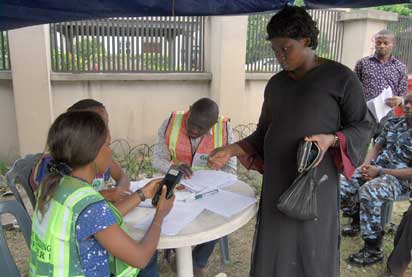
PVC test-run: INEC officials attending to a registered voter in the Port Harcourt Local Government Area Ward One, unit 23, during the card readers test-run in Rivers State, yesterday. Photo: Nwankpa Chijioke.
“In all cases from 11(b) to 11(e) the Presiding Officer shall fill the appropriate forms in the PU booklet and make a report. Affected voters in 11(b) and 11(e) qualify to be issued ballot papers after consultation with Polling Agents.
“Where the Permanent Voters’ Card, PVC, presented by the voter is not for the Polling Unit, the APO I shall politely inform the voter and advise him/her to proceed to the appropriate Polling Unit.”
“Any person who presents the PVC of another person with an intention to use it to vote, shall not be allowed to vote and may be liable to arrest and prosecution.
“In the event of sustained malfunction of the Smart Card Reader (SCR), the Presiding Officer (PO) shall immediately inform the Supervisory Presiding Officer
(SPO), the Electoral Officer (EO), and the Electoral Operations Support Centre (EOSC) for replacement; suspend Accreditation and Voting until a new Card Reader is made available;
“Telephones and other electronic devices capable of taking pictures are not allowed in voting cubicles. Voters may come to the Polling Unit with telephones and other electronic devices provided that they do not take them to the voting cubicles or take pictures of other voters while they are voting.
“After thumb printing the ballot, while still in the voting cubicle, the voter shall carefully fold the marked ballot paper in the same manner that the Presiding Officer had pre-folded the ballot before
issuing it to the voter and proceed to drop it in the appropriate ballot box. Additional ballot boxes will be provided where necessary.
“Presiding Officers shall place the ballot boxes not more than two meters away from the voting cubicle, in the direction of the Presiding Officers and away from the polling agents.
“After casting his/her ballot, the voter is free to remain within the vicinity of the Polling Unit to witness the sorting and counting of votes and the announcement of results, provided he/she is orderly.
“Where the total number of votes cast at a Polling Unit exceeds the number of registered voters in the Polling Unit, the result of the election for that Polling Unit shall be declared null and void, and a report in that regard shall be made to the collation officer.
“Similarly, where the total number of votes cast at a Polling Unit exceeds the total number of accredited voters, the outcome of the election shall be declared null and void, and a report in that regard shall made to the collation officer.
“Where after a crosscheck and recount, the sum of spoiled ballot papers, rejected ballots and valid votes is not equal to the total number of used ballots, an anomaly exists, and the Presiding Officer shall submit a written report to the RA/Ward Collation Officer.”
According to Medulla medical service, one of the way to be rich in new year is to be an egg Donor. How do I become one To qualify as an Egg Donor Candidate, you must: 1. Be between the ages of 21 and 29 years old Be in good health, physically and emotionally 2. Have a BMI between 19 and 25 (being overweight or underweight can affect egg quality) 3. Have not smoked cigarettes in the past 12 months 4. Have regular monthly menstrual cycles 5. Not currently on Depo-Provera, Norplant, Nexplanon, or any brand of a hormonal IUD 6. Have not travelled to a country or countries affected by the Zika virus in the last 6 months 7. Be willing to undergo a medical and psychological evaluation 8. Be willing to take injectable, medication 9. Be free from sexually transmitted diseases within the last year 10. Have no history of drug use, urine toxicology tests will be completed during screening process 11. Refrain from getting any tattoos or body piercings ...
The IELTS Writing test is designed to assess a wide range of writing skills, including how well you write a response appropriately organise ideas use a range of vocabulary and grammar accurately Academic Writing Format: Write in a formal style in the IELTS Academic Writing test. In Task 1 you will be presented with a graph, table, chart or diagram. You will be asked to describe, summarise or explain the information in your own words. This might involve describing and explaining data, describing the stages of a process or how something works, or describing an object or event. In Task 2 you will be asked to write an essay in response to a point of view, argument or problem. You should find the issues interesting and easy to understand. Timing: The IELTS Writing test takes 60 minutes. Spend 20 minutes on Task 1, and 40 minutes on Task 2. You will need to manage your own time, so make sure you move on to Task 2 after 20 minutes. Number of Questions: 2 questions Task ...
Eduard Charlemont ,The Moorish Chief,1878 Photo: Essential African Knowledge The word Moor conjures up many thoughts. Due to required Shakespearean reading in school, we may have heard this word used to describe blacks. But as more facts emerge, we are gradually learning just how powerful the black presence was in olden times. Moorish Empire of North Africa…Afri Asiatic Anthropology Blog The Oxford English Dictionary describes a Moor as, “A member of a north-western African Muslim people of mixed Berber and Arab descent. In the 8th century, they conquered the Iberian Peninsula, but were finally driven out of their last stronghold in Granada at the end of the 15th century.” The Dutch language used the word Moor and Moorian to describe blacks. Today, the wor...
Born in the Egbaland of the Yoruba people of West Africa at the beginning of the nineteenth century, Tinubu learned commerce from her grandmother, a successful trader. As a young woman Tinubu married a local man and bore him two sons, but she was widowed following the family’s migration to the town of Abeokuta in 1830. Shortly afterward she met Adele, a deposed king of Lagos, married him, and moved with her new husband and sons to the coastal town of Badagry, where Adele was temporarily recognized as ruler. Tinubu arrived in Badagry at a time when the then illegal Atlantic slave trade was peaking on the eastern Slave Coast. Although her sons soon died, she used two slaves, allegedly a gift from her father, to trade between Abeokuta and the coast in slaves and other commodities. Never again blessed with children, she invested her growing income from trade in slaves and other retainers, beginning the process of amassing personal followers and expanding her commercial operations. I...
The Central Bank of Nigeria on Wednesday knocked commercial banks across the country for not promoting the e-Naira launched with fanfare by the President, Major General Muhammadu Buhari(retd.), in October, 2021. The apex bank also explained the operational benefits of its newly introduced eNaira to the public. Officials of the CBN took turns in Kaduna on Wednesday to lecture youth corps members, hundreds of students from tertiary institutions across the state and other members of the public on the eNaira initiative. Head, Development Finance Department of the CBN, Aminu Muhammad, an assistant director, said financial institutions under the purview of the CBN were supposed to play these critical roles in growing our economy. Speaking at the CBN Fair which held in Kaduna and simultaneously in Kano, Muhammad said the commercial banks were not effective in promoting the eNaira. Copyright PUNCH
1. Objective : The objective of the Bleeding Time (BT) test was to evaluate the time taken for small blood vessels to stop bleeding after a standardized skin puncture, thus assessing platelet function and vascular integrity. 2. Principle : The test was based on the principle that bleeding time reflects platelet plug formation at the site of vascular injury. Any defect in platelet number, function, or vessel wall integrity prolonged the bleeding time. 3. Materials : Sterile lancet or bleeding time device Stopwatch Filter paper (Whatman No. 1) Sphygmomanometer Alcohol swab Ruler Cotton and adhesive bandage 4. Procedure (Duke’s Method or Ivy’s Method): (Ivy’s Method – more standard): 1. The patient’s forearm was cleaned and a blood pressure cuff was inflated to 40 mmHg. 2. A standardized incision (usually 5 mm long, 1 mm deep) was made on the volar surface using a lancet. 3. The stopwatch was started immediately. 4. Every 30 seconds, the blood was gently blotted with filter pa...
Some of the athletes who will be representing Nigeria at the Commonwealth Games in Glasgow are crying over their condition since their arrival in Scotland over the weekend. With the Games set to kick off on Wednesday, delegates from the participating countries are already on ground and could be seen on the streets of Glasgow, especially around the games village, rightly fitted with track suits bearing their national colours. This is in contrast to the Nigerian athletes, who confirmed that they have not been supplied with kits and as a result they are dressed in different colours. Only those participating in the track and field events have kits, from other events they took part in. Others have no kits says, a senior Nigerian athlete at the Games, “it is embarrassing seeing Nigerian athletes in tatters,” he continued, adding “some are even wearing bathroom slippers." “The athletics team was lucky to have their own personal kits from previous outings. Nobody has been supplied with k...
Comments
Post a Comment